
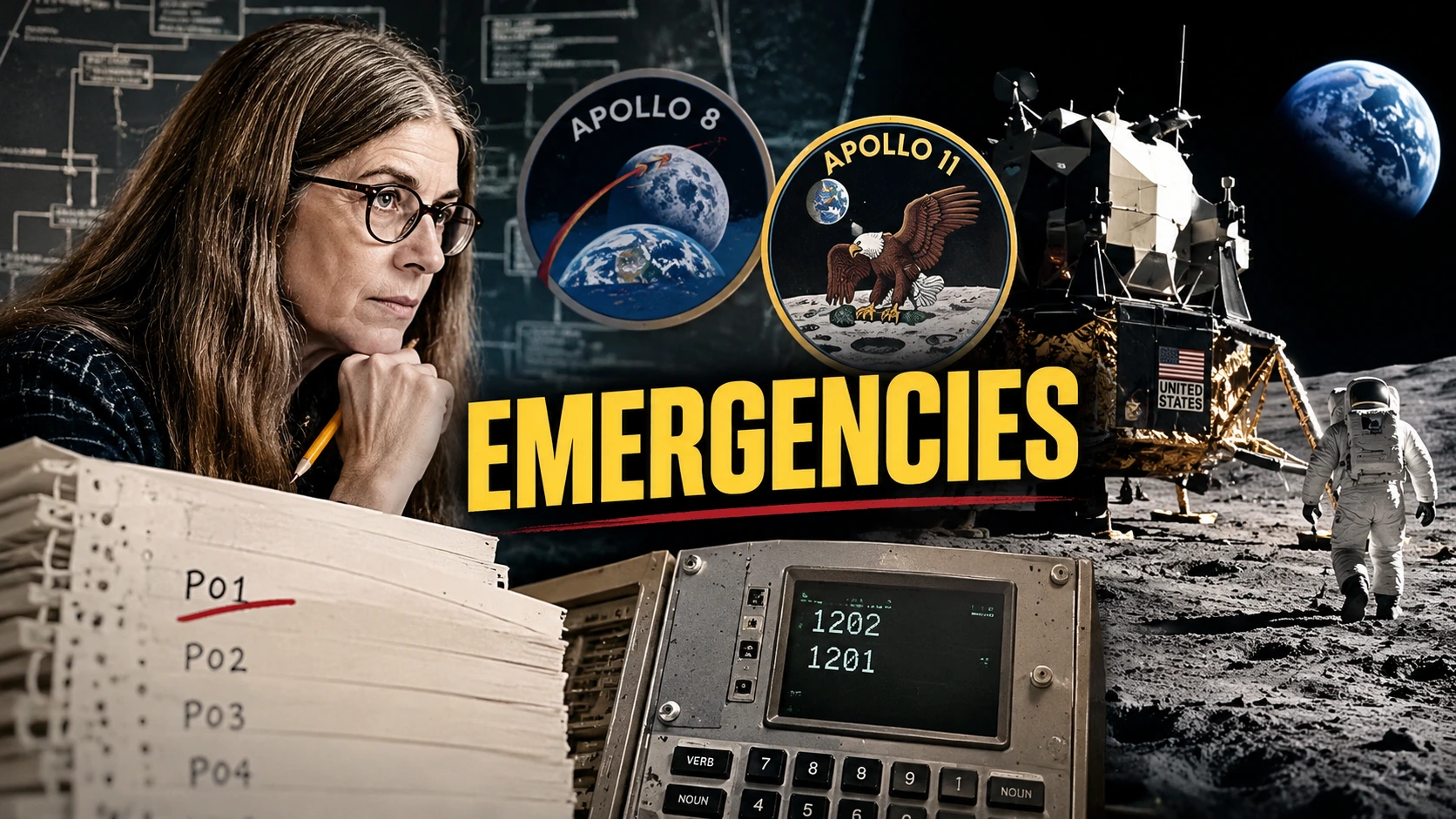
In December 1968, astronaut Jim Lovell accidentally activated the wrong computer program aboard Apollo 8, disrupting important navigation information during the spacecraft's journey back from the Moon. Seven months later, Apollo 11's guidance computer began displaying alarming error codes while Neil Armstrong and Buzz Aldrin were descending toward the lunar surface.
Both emergencies involved software developed at MIT's Instrumentation Laboratory, where Margaret Hamilton led the Apollo flight-software effort. Yet the nature of the problems, the protections available and the actions needed to recover were significantly different.
I compared MIT's historical account with explanations from Apollo software engineers and NASA's technical records. What emerged was a more interesting story than the familiar claim that Hamilton's software saved the Moon landing.
Apollo 8 revealed the consequences of rejecting a safeguard Hamilton had recommended. Apollo 11 demonstrated the value of an emergency recovery system developed by the larger engineering team she led. Examining those differences helps establish what Hamilton personally contributed, what belonged to her colleagues, and why her approach to software reliability was so important.
Apollo 8: Mistake Hamilton Had Predicted
The Apollo 8 emergency began with a seemingly ordinary computer command. During the mission's return journey, Jim Lovell inadvertently selected P01, a program intended for initialization before launch.
P01 was legitimate software, but it was being activated at the wrong stage of the mission. Its execution disrupted navigation information that the astronauts needed for subsequent operations, forcing engineers on Earth to develop a recovery procedure.
What makes this incident remarkable is that Hamilton had already identified the danger. The possibility of activating P01 during flight was not an unforeseen problem discovered for the first time aboard Apollo 8.
According to Hamilton's recollections, the warning originated during a visit to the MIT laboratory by her young daughter, Lauren. While playing astronaut in a command-module simulator, Lauren accidentally selected P01 after the simulated mission had already begun.
The simulator crashed, prompting Hamilton to investigate what had happened. She realized that an astronaut entering the same command during an actual mission could interfere with navigation data at a critical moment.
Hamilton recommended changing the software to prevent the prelaunch program from being activated during flight. However, the proposed protection was rejected because the astronauts were considered sufficiently trained to avoid that particular mistake.
She succeeded in getting a warning incorporated into the program documentation, but the software itself remained capable of accepting the inappropriate command. MIT's historical account of Hamilton's work confirms that her proposed protection was implemented only after Apollo 8 experienced the problem.
What the Apollo 8 Recovery Actually Required
When Lovell inadvertently selected P01, Hamilton recognized the similarity to the simulator incident. She and other MIT specialists worked with NASA to determine how the affected navigation information could be restored.
The recovery did not require restarting a completely failed computer. In her oral-history interview with the Computer History Museum, Hamilton explained that the computer remained capable of accepting commands, but the disturbed navigation information had to be entered again.
That distinction changes how I interpret the emergency. The spacecraft had not simply lost all computing capability; it had lost information needed for navigation because a functioning program had been executed under inappropriate conditions.
Engineers developed the necessary recovery procedure, and the mission continued successfully. Apollo 8 returned safely to Earth on December 27, 1968, after completing humanity's first crewed journey around the Moon.
I find Hamilton's earlier recommendation more significant than the fact that engineers eventually resolved the emergency. The recovery demonstrated technical competence, but her warning demonstrated an ability to recognize how a reliable computer could still become dangerous when it accepted an inappropriate command.
The weakness was not that P01 performed its intended initialization functions incorrectly. It was that the system permitted those functions to operate during a mission phase when their effects were undesirable.
Had Hamilton's proposed protection been implemented before Apollo 8, this particular mistake could have been prevented at the software level. That does not establish what would have happened under every possible circumstance, but it shows that the actual incident matched a vulnerability she had previously identified.
My assessment is that Hamilton's individual contribution here was unusually clear: she identified a specific operational risk, proposed a practical safeguard, and continued advocating that protection despite resistance.
Her argument challenged an assumption that had influenced the software's design: highly trained people could be trusted not to make certain mistakes. Apollo 8 demonstrated why that assumption was insufficient for a system operating hundreds of thousands of miles from Earth.
Apollo 11: A Computer Overload
On July 20, 1969, Apollo 11's lunar module Eagle was descending toward the Moon when its guidance computer displayed alarm 1202. Additional alarms appeared as Armstrong and Aldrin continued their approach, including another code, 1201.
The alarms indicated that the computer's executive software had exhausted resources needed to schedule work. They were particularly concerning because the computer was responsible for essential navigation, guidance, and control operations during the landing.
Unlike Apollo 8, the problem did not begin with an astronaut accidentally launching a program intended for another mission phase. It originated from an unexpected interaction between the rendezvous radar equipment and the guidance computer's limited processing capacity.
The Radar Problem Behind the Alarms
The Apollo Guidance Computer was designed to perform several operations within extremely restricted hardware resources. Its software had to coordinate time-sensitive tasks, perform guidance calculations, process instrument information, and respond to commands without allowing competing activities to disrupt essential operations.
During the lunar descent, the rendezvous radar was configured for a possible abort and subsequent rendezvous with the command module. In certain operating modes, the radar's interface electronics could generate rapid, unintended counter activity that consumed processing time inside the guidance computer.
The resulting loss of computing capacity was not initially understood by the astronauts or Mission Control. The underlying problem involved the interaction between radar hardware, its operating configuration, and the computer's scheduling system.
Don Eyles, who developed important portions of the lunar-module descent software, later reconstructed the failure in considerable technical detail. His analysis estimated that the radar-related activity consumed approximately 13% of the computer's processing capacity under the conditions experienced during Apollo 11.
That percentage is important because the guidance computer was already heavily occupied with landing operations. As the available processing margin narrowed, losing another substantial fraction of computing time meant that scheduled work could accumulate faster than the computer could complete it.
The result was a scheduling problem that eventually exhausted temporary memory resources.
According to Peter Adler's explanation preserved in NASA's Apollo 11 Lunar Surface Journal, alarm 1202 indicated that no available core sets remained for scheduling another job. Alarm 1201 indicated a shortage of a different temporary resource, known as a vector accumulator area.
These codes therefore described specific internal resource problems rather than a vague warning that the computer was malfunctioning. Understanding that distinction is essential to understanding why the software's response mattered.
How the Computer Continued Working
The Apollo Guidance Computer used an executive system that could assign different priorities to scheduled jobs. This meant that important operations could interrupt less urgent work rather than waiting for every earlier operation to finish.
When the executive ran out of scheduling resources, the software could initiate a controlled restart. Instead of indiscriminately restarting every operation, the recovery mechanism reconstructed selected essential processes while clearing work that did not need to survive the restart.
That protection was particularly valuable during Apollo 11 because incomplete jobs had begun accumulating. Some had not finished their calculations before the next scheduled instance of the same work was due to begin.
The restart mechanism could remove these accumulated unfinished jobs and reconstruct the current work required for continued operations. Certain less essential functions, including a monitoring display, could be dropped to reduce the load.
This was more sophisticated than simply instructing the computer to ignore radar information. The software recognized that its scheduling resources were exhausted, initiated recovery, and attempted to maintain the computations necessary for the spacecraft's operation.
Eyles's technical reconstruction reveals another detail that simplified versions of the story often miss. During a later phase of the descent, some of the essential computations themselves left so little spare capacity that the software could not eliminate the overload permanently.
Repeated restarts still occurred, but the computer continued operating rather than suffering a complete collapse. Armstrong subsequently reduced the computational burden by changing the spacecraft's control mode and continuing the final approach using a less demanding landing program.
I consider this distinction important because it prevents the recovery software from being portrayed as an almost magical solution. The system did not remove the underlying hardware interaction, and it did not guarantee that every necessary computation could continue under unlimited additional demands.
Instead, it provided a structured way to recover from resource exhaustion while preserving enough critical functionality for the descent to continue.
Why NASA Could Continue the Landing
The software's recovery capabilities were only one part of the successful response. Mission Control still needed to determine whether the alarms represented an immediate danger requiring the landing to be aborted.
Flight controller Steve Bales and computer specialist Jack Garman helped assess the alarms in Houston. Their judgment was based on the meaning of the error codes and the fact that the computer was continuing to perform essential operations.
The decision to proceed was made without a complete understanding of the radar-related cause. Engineers investigated the problem in detail after the landing, when they could examine the system's behavior and identify the unexpected processing demands.
Fred Martin, an MIT engineer involved in the Apollo guidance program, later recalled the uncertainty experienced by the engineering team as the alarms appeared. His account makes clear that understanding the alarms and understanding their underlying cause were not the same thing.
From my reading, this is where the software's engineering value becomes clearest. The recovery system did not independently decide that landing was safe; it kept the guidance computer sufficiently functional for trained people to make that decision.
Without that recovery capability, Mission Control might have faced an entirely different problem. But the available evidence does not justify claiming that software alone guaranteed the landing or that every alternative computer design would necessarily have failed.
Difference Between the Two Emergencies
Initially, the incidents appear to support the same conclusion: Margaret Hamilton's software engineering helped Apollo missions survive serious computer problems. However, comparing the actual failure mechanisms reveals two different types of reliability.
Apollo 8 was primarily a failure of prevention. A program designed for initialization was allowed to run during flight, even though Hamilton had previously recognized the danger and proposed restricting its use.
The response was largely corrective. Engineers had to identify the mistake and restore the information that had been affected.
Apollo 11 was primarily a demonstration of recovery under overload. The computer encountered unexpected processing demands that exhausted scheduling resources, but its executive and restart mechanisms allowed critical functions to continue.
The response was partly automatic. Mission Control then evaluated the continuing alarms and decided whether the spacecraft could safely proceed.
I find the distinction more informative than treating both incidents as examples of software simply saving astronauts. Apollo 8 concerns an error that should have been blocked before it affected the system, while Apollo 11 concerns a disturbance that the system needed to tolerate after it occurred.
There is also an important difference in what the incidents reveal about engineering decisions.
Before Apollo 8, Hamilton's recommendation competed with confidence in astronaut training. A stronger software protection was considered unnecessary until an actual mission demonstrated otherwise.
Before Apollo 11, the software already contained mechanisms designed to respond to serious interruptions and resource problems. Those capabilities were present even though the particular radar-related overload had not been anticipated.
To me, these incidents illustrate two complementary responsibilities in critical software development. Engineers must identify and eliminate predictable sources of failure wherever practical, while also preparing systems to respond when an unexpected problem escapes prevention.
Neither approach can replace the other. A system that only prevents known mistakes remains vulnerable to unfamiliar failures, while a system that relies entirely on recovery may still suffer avoidable damage before its safeguards become effective.
That is the strongest conclusion I can draw from comparing the emergencies. Their significance lies not in proving that Apollo software was incapable of failure, but in showing why different failures require different forms of protection.
Margaret Hamilton's Contribution
The historical record provides strong reasons to recognize Hamilton's leadership, but it also places limits on how much credit can reasonably be assigned to one person.
Hamilton directed the MIT organization responsible for Apollo's onboard flight software. She helped establish an approach to development that emphasized software reliability, error detection, prevention, recovery, and extensive testing.
MIT's October 2026 retrospective describes her as a central figure in developing software engineering as a discipline. It also credits her leadership with helping the Apollo program create software capable of prioritizing mission-critical work during unexpected conditions.
However, the technical foundations of Apollo's recovery capabilities were developed collaboratively.
J. Halcombe Laning designed the priority-driven executive system that determined how jobs were scheduled. Engineers including Don Eyles and Peter Adler developed important lunar-module flight routines, while Allan Klumpp contributed to the lunar-descent guidance design.
Numerous other programmers, mathematicians, hardware specialists, and testing personnel were responsible for making those systems function together. NASA's flight controllers and astronauts then had to operate the spacecraft and respond appropriately when unexpected conditions occurred.
In his technical account of the lunar-module guidance computer, Eyles specifically describes Laning's executive architecture and the extensive testing involved in making restart protection work. That evidence makes it inappropriate to suggest Hamilton personally wrote every routine responsible for Apollo 11's recovery.
I would therefore assign Hamilton's contribution differently in the two incidents.
For Apollo 8, the evidence points to a clearly identifiable personal intervention. Hamilton recognized the P01 vulnerability, warned about the potential consequences, and advocated a change before the problem occurred during a real mission.
For Apollo 11, her contribution is better understood through engineering leadership and the development of reliable flight software across a large team. The successful recovery demonstrated the importance of that organization's approach, but it was not the achievement of Hamilton alone.
This distinction does not weaken her historical importance. In fact, I think it explains her contribution more convincingly than the familiar image of one extraordinary programmer personally rescuing a spacecraft from disaster.
A complex software system requires more than individual technical brilliance. It requires architectural decisions, coordinated development, testing, careful integration, and a willingness to examine how the entire system might behave under conditions its designers did not intend.
Hamilton's work at MIT placed her at the center of those responsibilities. Her documented concern with human mistakes and unexpected conditions helps explain why her influence extended beyond the particular code she personally developed.
My Final Assessment
After examining the two emergencies, I consider Margaret Hamilton's most important contribution to be her insistence that software reliability must be treated as an engineering responsibility rather than an assumption.
Apollo 8 provides evidence of her personal ability to anticipate a specific operational failure. Apollo 11 provides evidence of the broader software engineering achievement accomplished under her leadership, where carefully designed recovery mechanisms helped a spacecraft continue operating despite unexpected demands.
I would not credit her with single-handedly saving either mission. The evidence supports a more substantial and historically defensible conclusion: Hamilton helped establish the engineering culture and practices that made software error prevention and recovery central to the Apollo program.
The difference matters because Apollo's computer emergencies were not resolved through one person's foresight or one remarkable piece of code. They were handled through a combination of engineering design, software protections, technical expertise, and human judgment.
For me, Hamilton's legacy is most visible in the connection between what went wrong on Apollo 8 and what continued working on Apollo 11. One incident demonstrated the cost of leaving a known vulnerability unprotected, while the other demonstrated the value of building a system capable of recovering when an unexpected problem occurred.
Together, they show why her approach to software engineering was so consequential. The Apollo program needed software that could do far more than execute instructions correctly under ideal conditions, and Hamilton helped lead the effort to make that possible.
Related Stories

Why Is Charles Babbage Called the Father of the Computer?
Charles Babbage never completed the machine that made him famous. Yet his Analytical Engine introduced several ideas that later became fundamental to programmable computers.