
Before computers became machines, the word “computer” often referred to a person whose job was to perform calculations. Human computers worked through large sets of numbers for astronomy, navigation, engineering, finance, insurance, and scientific research.
Producing a reliable mathematical table could involve several stages. Numbers had to be calculated, checked, copied, typeset, and finally printed. Every additional stage created another opportunity for a mistake to enter the finished work.
Charles Babbage became deeply interested in this problem during the early nineteenth century. Instead of asking how human calculators could simply work more carefully, he began considering whether machinery could perform repetitive calculations automatically.
That question eventually led him toward two very different machines.
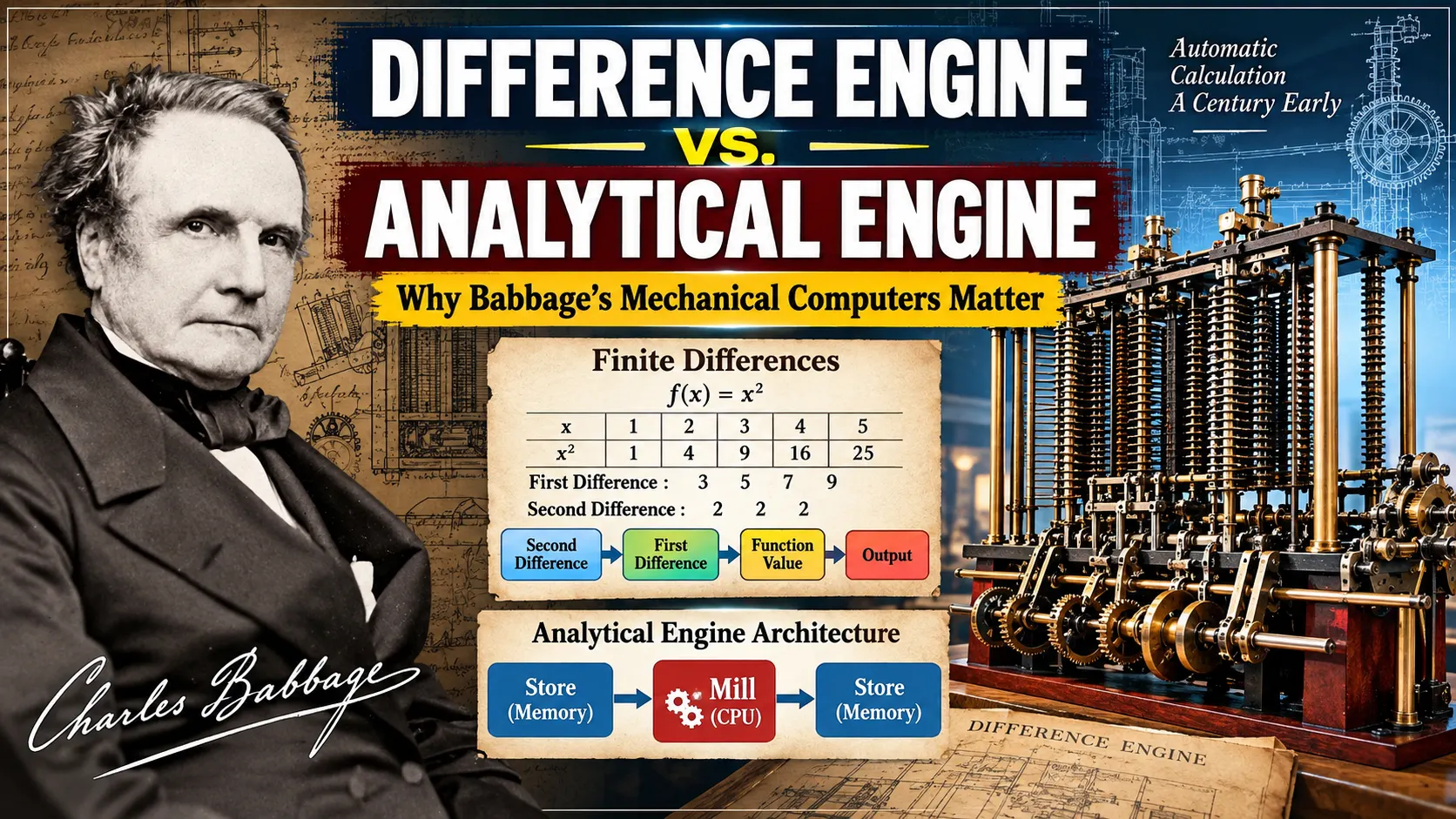
The Difference Engine was designed primarily to calculate and produce mathematical tables. The later Analytical Engine was far more ambitious. It was intended to store numbers, perform different arithmetic operations, follow instructions, repeat sequences, and alter the course of a calculation according to intermediate results.
The movement from the Difference Engine to the Analytical Engine is one of the most important parts of Babbage’s story. He began by trying to automate a specialized mathematical task and ended up developing ideas that strongly resemble several basic principles of programmable computing.
Difference Engine vs. Analytical Engine
The two machines are often discussed together, but they were not simply earlier and later versions of the same calculator.
Babbage began developing the Difference Engine in the early 1820s. He conceived the Analytical Engine in the 1830s and continued revising its design for decades.
The Difference Engine was intended to automate a particular mathematical technique. The Analytical Engine, by contrast, was designed so that the same machinery could perform different calculations depending on the instructions supplied to it.
FeatureDifference EngineAnalytical EnginePrimary PurposeAutomatic production of mathematical tablesGeneral-purpose programmable computationMain Mathematical MethodFinite differences using repeated additionAddition, subtraction, multiplication, and divisionProgrammingNot designed as a general programmable machineControlled through sequences of punched cardsArchitectureMechanical columns holding values and differencesSeparate Mill for calculation and Store for valuesControlFixed around the tabulation processIncluded iteration and conditional control conceptsMemoryRegisters needed for the current calculationMajor designs proposed roughly 1,000 numbers of up to 50 decimal digitsThe important difference was therefore not merely that the Analytical Engine was bigger or more complicated.
The Difference Engine automated a mathematical process. The Analytical Engine was intended to change what it did according to a sequence of instructions.
That was a major conceptual shift from automatic calculation toward programmable computation.
How the Difference Engine Worked
Finite Differences
The Difference Engine relied on a mathematical technique known as the method of finite differences.
This technique was especially useful for Babbage because it allowed certain polynomial calculations to be reduced to repeated addition. Addition was much easier to reproduce mechanically than repeatedly carrying out multiplication and division.
Consider the simple function:
f(x) = x²
Its values for consecutive numbers are:
xx²112439416525Now look at the difference between each result.
The first differences are:
3, 5, 7, 9
The differences between those numbers are:
2, 2, 2
The second difference remains constant.
Once the correct starting values are established, a machine can therefore generate the next value through a sequence of additions instead of calculating every square independently.
The basic flow can be understood simply as:
Second Difference → First Difference → Function Value → Output
The second-difference value updates the first difference. The first difference then updates the main calculated value, and the resulting number can be sent toward the output mechanism.
Higher-degree polynomials require additional difference columns, but the underlying idea remains the same.
This was an elegant mechanical solution because Babbage could transform complicated mathematical work into a predictable chain of additions.
Automatic Output
Babbage was concerned with more than calculating the correct answer.
Imagine that a machine produces a perfect result but someone then copies that result incorrectly before it reaches the printed page. Much of the advantage of automatic calculation would immediately be lost.
Babbage therefore wanted the machinery to help automate the output process as well.
His Difference Engine designs included mechanisms intended to move calculated values toward printed results. In later designs, the output system became sophisticated enough to include automatic formatting and the preparation of material that could be used for printing plates.
This was important because Babbage was attacking two separate sources of error: incorrect calculation and incorrect transcription.
Babbage did not create a direct technological path from Victorian machinery to modern electronic computers, but his designs anticipated several ideas that later became central to computing. That broader historical context also helps explain why Charles Babbage is called the father of the computer, even though he never completed the Analytical Engine during his lifetime.
Why Difference Engine No. 1 Was Never Finished
Difference Engine No. 1 became an enormous engineering undertaking.
By 1830, one developed form of the machine would have required around 25,000 parts and weighed several tons if completed. Its number wheels, shafts, carrying mechanisms, gears, structural frames, and output components all had to operate together with considerable precision.
Babbage worked closely with the skilled engineer and toolmaker Joseph Clement, whose workshop manufactured important portions of the machine.
Their relationship eventually deteriorated during disagreements involving workshop arrangements, payments, and equipment. Construction stopped during the early 1830s.
It would be misleading, however, to reduce the failure to the idea that Victorian engineers simply lacked the precision required to build Babbage’s machine.
Later reconstruction work demonstrated that Babbage’s mature Difference Engine designs could operate using engineering tolerances compatible with nineteenth-century manufacturing.
The real problem involved several factors working together: the enormous scale of the project, rising costs, management problems, Babbage’s changing designs, his breakdown with Clement, political circumstances, and declining government confidence.
By the time the project finally lost government support in 1842, the British Treasury had spent roughly £17,500, an extraordinary amount for a machine that had never been completed.
Yet while the Difference Engine project was struggling, Babbage had already begun developing an even more ambitious idea.
The Analytical Engine
The Analytical Engine marked a profound change in Babbage’s thinking.
Rather than designing another machine dedicated primarily to producing mathematical tables, he began imagining a mechanism capable of performing different kinds of calculations according to instructions.
Babbage conceived the Analytical Engine during the 1830s and continued developing it throughout much of the rest of his life.
Because he repeatedly redesigned the machine, there was never one permanently fixed Analytical Engine specification. Different drawings and plans show the concept evolving over time.
Nevertheless, several central ideas remained remarkably consistent.
The most important were the separation between calculation and storage, the use of punched instructions, and the ability to repeat or alter sequences of operations.
The Mill and the Store
Babbage divided the Analytical Engine into two major functional areas.
The Store held numbers and intermediate results.
In one important design, Babbage envisioned space for approximately 1,000 numbers, with each capable of containing as many as 50 decimal digits.
The Mill performed the mathematical operations.
The basic relationship can be represented very simply:
Store → Mill → Store
Numbers needed for a calculation would move from the Store into the Mill. The Mill would carry out the required operation, and the resulting number could then be returned to the Store for later use.
For example, two stored values could be selected, sent into the Mill for addition, and the new result could then be stored again.
This arrangement resembles the modern separation between memory and a processor.
The comparison should not be pushed too far. Babbage was designing a decimal mechanical system driven by physical motion, not an electronic stored-program computer.
Even so, separating the place where values were held from the mechanism that operated on those values was an extraordinarily important architectural idea.
Punched Card Programming
The Analytical Engine’s proposed control system was equally striking.
Babbage drew inspiration from the Jacquard loom, which used punched cards to control complex patterns in woven textiles.
He realized that punched cards could also control mathematical operations.
Instead of rebuilding the machinery whenever a different calculation was needed, the sequence of cards could tell the Analytical Engine what to do.
Babbage described several important card types.
Operation Cards
Operation cards told the machine which mathematical operation should be performed.
These could direct the Mill toward processes such as addition, subtraction, multiplication, or division.
Variable Cards
Variable cards helped control which values were transferred between the Store and Mill.
They could identify the quantities required for a calculation and determine where resulting values should be placed.
Number Cards
Number cards could introduce numerical constants required by a particular calculation.
The exact design of the card system evolved as Babbage revised the Analytical Engine, but the broader principle remained powerful.
The instructions controlling the calculation existed separately from the main arithmetic machinery.
That distinction is one of the features that made the Analytical Engine genuinely programmable in concept.
Loops and Conditional Control
The Analytical Engine was intended to do more than follow one long, unchanging sequence of instructions.
Babbage developed ways for sections of a card sequence to be repeated. Instead of physically reproducing the same instructions over and over, the machine could return to an earlier part of the sequence and execute it again.
In modern language, this resembles a loop.
Babbage also explored forms of conditional control in which the direction of a calculation could depend on a result produced during the computation.
Modern programmers might compare the idea with an IF condition or a WHILE loop, although those terms did not belong to Babbage’s period.
The important historical point is not the modern terminology. It is that the machine was intended to do more than mechanically follow one rigid line of operations.
A previous result could influence what happened next.
That represents a much more advanced concept of computation than an ordinary calculator executing a fixed sequence.
Mechanical Gear Design and Innovation
The Analytical Engine sounds surprisingly modern when described using words such as memory, processing, programming, and conditional control.
Physically, however, every one of these functions had to be reproduced with mechanical components.
There were no electronic circuits, silicon chips, or transistors.
Everything depended on wheels, shafts, levers, cams, clutches, racks, gears, and carefully timed motion.
Figure Wheels
Babbage’s calculating engines were decimal digital machines.
Individual figure wheels could occupy positions representing the digits 0 through 9.
Several wheels arranged together could represent a larger number. One wheel might correspond to units, another to tens, another to hundreds, and so on.
A number therefore existed physically in the positions of the wheels.
When a calculation occurred, mechanical movement changed those positions.
That sounds simple until carrying is required.
If one wheel moves from 9 back to 0, the wheel representing the next decimal place must advance.
Handling those carries efficiently became one of Babbage’s most interesting mechanical challenges.
The Anticipating Carry Mechanism
Consider the calculation:
999,999 + 1 = 1,000,000
The first carry begins at the right-hand side, but it has to propagate through every digit.
In a basic mechanical system, each carry could be completed before the next one begins. With numbers containing many digits, a long chain of carries could become a serious performance bottleneck.
Babbage developed an anticipating carriage mechanism designed to reduce that problem.
Instead of treating every carry as a completely separate event, the machine could prepare for several carries more efficiently.
This detail is important because it shows how deeply Babbage thought about actual machine performance.
He was not simply describing a theoretical computer. He was trying to solve the physical problems that would appear when mathematics was translated into moving machinery.
Control Barrels
The Analytical Engine also needed mechanisms to coordinate the many small movements required to perform a single arithmetic operation.
Babbage developed rotating control barrels fitted with studs.
As the barrels rotated, the studs could trigger specific actions at particular stages of an operation.
A multiplication instruction, for example, might appear to be one command from the programmer’s perspective, but the physical machine would need to execute numerous smaller mechanical actions in the correct order.
The control barrels helped organize those internal steps.
Modern historians sometimes compare this principle with microcode, in which a higher-level instruction is carried out through a series of simpler internal operations.
That is a modern analogy rather than Babbage’s own terminology, but it helps explain the different layers of control inside the machine.
The relationship can be understood as:
Punched Instructions → Internal Control Mechanisms → Mechanical Arithmetic
The punched cards determined the larger computational sequence, while the internal mechanisms controlled the physical movements needed to carry out each instruction.
Why the Analytical Engine Was Never Completed
The Analytical Engine was conceptually extraordinary, but designing such a machine and actually manufacturing one were very different challenges.
Mechanical Scale
The proposed machine would have required a huge collection of mechanical components working together reliably.
The Store needed large banks of number wheels. The Mill required mechanisms capable of several arithmetic operations. Card readers, control systems, shafts, carrying mechanisms, output equipment, and power transmission all had to operate as one coordinated system.
Because Babbage repeatedly changed the Analytical Engine during decades of design work, claims that the machine required one exact number of components should be treated carefully.
There was no single final Analytical Engine blueprint that represents every stage of the project.
What is clear is that the machine would have been extraordinarily large and mechanically complicated.
Financial and Political Barriers
Money was another major obstacle.
The British government had already spent heavily on Difference Engine No. 1 without receiving the completed machine it had expected.
From the perspective of government officials, funding an even more ambitious mechanical computer therefore involved considerable financial risk.
When Robert Peel’s government finally ended support for the Difference Engine in 1842, Babbage did not receive a comparable government-funded program to construct the complete Analytical Engine.
He continued working on its design, but designing such a machine privately and financing its full manufacture were entirely different matters.
Continuous Redesign
Babbage also continued improving the Analytical Engine instead of freezing one version for construction.
This tendency is sometimes presented simply as a weakness, but the situation was more complicated.
His redesigns produced important improvements in arithmetic, control, data movement, and machine organization.
At the same time, repeated redesign created a practical problem.
Large engineering projects eventually reach a stage when the design must stop changing so that manufacturing can begin. Babbage continued exploring new possibilities rather than settling permanently on one final machine.
The result was unusual: the Analytical Engine became increasingly sophisticated as a design while remaining unfinished as a physical object.
Ada Lovelace and the Analytical Engine
Babbage’s work became closely connected with Ada Lovelace, whose writings helped explain the broader potential of the Analytical Engine.
In 1843, Lovelace translated an article by Italian engineer Luigi Federico Menabrea describing Babbage’s machine.
She then added an extensive collection of notes of her own.
Those notes were longer than the original article and explored the Analytical Engine in far greater detail.
One section described a procedure for calculating Bernoulli numbers using the machine.
The procedure is often described as the first computer program.
A more careful interpretation is that Lovelace published one of the earliest detailed algorithms specifically intended for execution by a programmable calculating machine. Babbage himself had already worked out program-like procedures while developing the Engine.
Lovelace’s most interesting contribution may therefore lie beyond the question of who should receive the title of “first programmer.”
She recognized that the Analytical Engine could potentially manipulate representations rather than merely calculate quantities.
If information such as musical relationships could be represented according to formal rules, she suggested, machinery might operate on those representations.
That idea anticipated a much broader understanding of computing.
Modern computers process text, photographs, music, video, and other information because each can ultimately be represented in a form the machine can manipulate.
Lovelace was considering that general possibility long before electronic computing made it practical.
The 1991 Science Museum Proof
Babbage never completed one of his own full-scale calculating engines during his lifetime.
More than a century later, however, one of his mature designs received an extraordinary practical test.
Between 1847 and 1849, Babbage developed Difference Engine No. 2, incorporating lessons learned from both his earlier Difference Engine work and his continuing development of the Analytical Engine.
The later design was considerably more elegant and efficient than Difference Engine No. 1.
In the twentieth century, the Science Museum in London began constructing Difference Engine No. 2 using Babbage’s surviving drawings.
The goal was not to modernize the design with electronic components. The project attempted to determine whether Babbage’s mechanical engineering could actually work.
The calculating section was completed in 1991, marking the two-hundredth anniversary of Babbage’s birth.
It operated successfully.
That 1991 achievement did not yet represent the entire Difference Engine No. 2 as Babbage had designed it.
The output apparatus, including its sophisticated printer and stereotyping mechanism, was completed later. With that work finished in 2002, the complete reconstruction based on Babbage’s design could finally be demonstrated.
The complete machine, including its calculating and output mechanisms, contains roughly 8,000 parts and weighs around five tons.
Its successful construction also challenged a simplistic explanation of Babbage’s nineteenth-century failure.
The problem was not merely that Victorian workshops were incapable of producing sufficiently precise components.
Funding, project management, political support, engineering scale, disputes with collaborators, and Babbage’s constantly evolving designs all played important roles.
Sources / References
- Babbage Engine, Computer History Museum — https://computerhistory.org/babbage/engines
- How It Works — Babbage Engine, Computer History Museum — https://computerhistory.org/babbage/howitworks
- The Babbage Engine — Computer History Museum — https://www.computerhistory.org/babbage/
Related Stories

How Luigi Galvani Tested Animal Electricity Without Metal
Luigi Galvani’s famous frog experiments led to a deeper question: was the electricity coming from the animal or from the metals in his apparatus? His later metal-free experiments helped move science toward the modern understanding of bioelectricity and electrophysiology.

Why Did Luigi Galvani’s Frog Leg Twitch Without an Electrical Machine?
Luigi Galvani found that a frog leg could twitch even after his electrical machine was removed. The explanation involved both electrically excitable animal tissue and the metals used in his experimental circuit.